
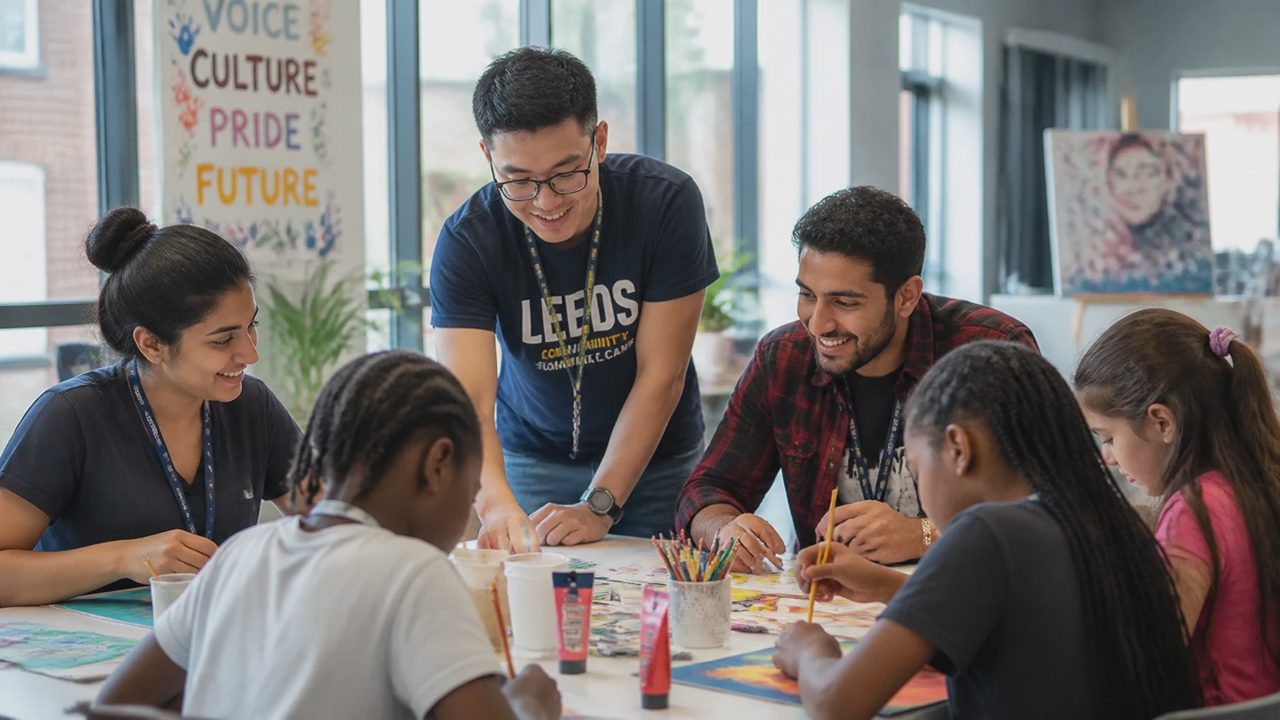
Cultural Dialogue Training in Action: What Our Summer Camp Taught Us About Helping Young People Belong
When our Art and Language Summer Camp with TKP in Leeds came to an end, we were left with an important reminder: young people do not build belonging through information alone.
They build it through relationships, shared experiences, honest conversation and the freedom to bring their whole identity into the room.
The camp gave us a practical opportunity to see our Cultural Dialogue model in action. Through creative activities, language learning, group participation and supportive interactions, young people were encouraged to express themselves, listen to others and recognise the value of their own cultural backgrounds.
This is the foundation of effective cultural awareness training. It is not simply about learning facts about different countries or celebrating cultural events. It is about helping educators and youth workers create environments where young people can ask questions, navigate difference and develop cultural pride while also feeling confident in their new surroundings.
What the Summer Camp Taught Us About Belonging
For young people moving between countries, communities or education systems, belonging can feel uncertain.
They may be managing:
- Anxiety about speaking or participating in an unfamiliar environment.
- Confusion about social expectations and communication styles.
- Loneliness after leaving family and familiar routines.
- Pressure to assimilate by hiding aspects of their background.
- Uncertainty about how their identity will be understood by others.
The summer camp showed us that belonging is not something an organisation can simply announce. It must be created through daily practice.
The format of the camp allowed young people to meet through shared activities rather than being defined by their differences. Art and language provided accessible ways to communicate. Group exercises created opportunities for participation. Informal conversations helped relationships develop naturally.
This approach matters because young people often express themselves more openly when they are doing something together. A creative activity, a language exercise or a shared discussion can become the starting point for trust.

The Cultural Dialogue Model in Practice
Our Cultural Dialogue training is built around four connected principles.
1. Identity is a strength
Young people should not feel that they must leave their cultural identity at the door in order to succeed in the UK.
At camp, language, personal experience and cultural knowledge became resources for participation. Young people were able to contribute from what they already knew while remaining open to new experiences.
This is an important shift for educators and youth workers. Instead of asking, “How do we help this young person fit in?” we can ask:
“How do we create a setting where this young person can contribute, grow and connect without losing their cultural pride?”
A culturally aware approach recognises that identity may include nationality, language, ethnicity, religion, family history, migration experience and changing ideas of home. These identities can be complex. A young person may feel connected to more than one place, or may be developing what we call an “in-between identity”.
Good support makes room for that complexity.
2. Belonging requires active participation
A young person may be physically present in a classroom or youth setting without feeling included.
The camp reinforced the importance of inviting participation in different ways. Not every young person will contribute confidently in a large group. Some may prefer creative work, paired discussion, practical tasks or time to observe before speaking.
Educators can strengthen belonging by offering:
- Different ways to participate.
- Clear explanations of activities and expectations.
- Opportunities for young people to share knowledge.
- Time to build trust before addressing sensitive topics.
- Encouragement that does not force personal disclosure.
Inclusion is not about putting a young person on the spot to represent an entire culture. It is about creating enough safety for them to choose how and when they participate.
3. Cultural pride and cultural learning can exist together
Cultural awareness training should not present culture as a set of fixed categories. It should help young people explore how culture influences values, communication, family life and perceptions of the world.
At the camp, young people were encouraged to learn from one another while remaining grounded in their own experiences. That balance is essential.
Cultural pride does not prevent adaptation. In many cases, it supports confidence during transition. A young person who feels secure in who they are may be better placed to understand new systems, build relationships and engage with education.
This principle is particularly relevant to international student support in the UK. Students may need practical help with accommodation, education pathways and daily life, but they also need support with the emotional experience of mobility. A successful transition is not only logistical. It is personal and cultural.
4. Honest conversations create deeper understanding
Cultural dialogue is not about avoiding difficult subjects. It is about creating the conditions for those subjects to be discussed respectfully.
Young people may have questions about accents, race, religion, nationality, family traditions or social expectations. They may also encounter stereotypes or misunderstandings.
Silence can leave them feeling isolated. An honest conversation, facilitated carefully, can transform confusion into understanding.
Educators and youth workers can support these conversations by:
- Encouraging young people to speak from personal experience.
- Asking open questions rather than making assumptions.
- Separating curiosity from judgement.
- Naming exclusion or bias when it occurs.
- Allowing discomfort while maintaining emotional and physical safety.
- Returning to the conversation after an incident, rather than treating it as resolved too quickly.
This requires confidence from adults. Cultural awareness training gives professionals practical strategies to begin and manage these conversations without pretending to have every answer.
What We Saw in the Young People
The summer camp was not a formal research study, and our full monitoring and evaluation documentation is still being finalised. We will add specific participation figures, feedback themes and evaluation findings once the M&E materials are available.
However, the camp experience gave us clear practice-based observations.
We saw young people become more willing to engage when activities were welcoming and collaborative. We saw the value of creating spaces where language and creativity could support communication. We saw connections develop through shared tasks rather than formal introductions alone.
We also saw how important it is for adults to notice quieter forms of participation. A young person may not speak first in a group but may contribute through artwork, peer support, humour, questions or a thoughtful response later.
These observations reinforce a central principle of our work: progress should be understood holistically. Confidence, emotional well-being, connection and cultural pride are part of a young person’s development alongside academic achievement.

What Educators and Youth Workers Can Take Forward
The camp model can be adapted to classrooms, after-school programmes, residential settings and community youth work.
Begin with the adults
Cultural awareness training should include reflection on the assumptions adults bring into a space.
Ask:
- What behaviours do we describe as confident, respectful or disruptive?
- Which communication styles do we reward?
- Whose history and cultural references are visible in our curriculum?
- Do our routines make space for different religious, cultural or family practices?
- How do we respond when a young person challenges our assumptions?
Professional learning becomes more effective when it connects personal reflection with practical action.
Use experiential activities
Young people learn about dialogue by practising it.
Useful activities may include:
- Identity mapping, with no requirement to disclose anything private.
- Story circles focused on belonging and transition.
- Creative projects exploring “where I am from” or “what I want people to understand”.
- Paired listening exercises.
- Scenario-based discussions about misunderstanding, exclusion or stereotyping.
- Group agreements for respectful conversation.
These activities should always be age-appropriate, voluntary where personal disclosure is involved and supported by clear safeguarding procedures.
Build dialogue into everyday routines
Cultural awareness should not appear only during a designated heritage month or one annual event.
It can be embedded in:
- Registration and pastoral conversations.
- Curriculum choices and reading materials.
- Food, celebrations and family engagement.
- Conflict resolution.
- Induction for new students.
- Staff meetings and professional supervision.
Small, consistent actions often have more impact than a single high-profile activity.
Who This Training Supports
Educators and youth workers
If you support diverse young people and feel uncertain about identity, belonging or difficult conversations, Cultural Dialogue training provides structure and practical tools.
Our training includes accredited learning, ready-made curriculum resources, classroom strategies and professional development certification. It helps professionals move from good intentions to confident, culturally responsive practice.
Parents sending children overseas
If you are sending your child to the UK, you want more than academic opportunity. You want trusted support that protects their well-being and helps them retain cultural pride.
Our wider support includes guardian services and welfare monitoring, alongside education and settlement guidance. Cultural awareness is part of that holistic approach. A young person is more likely to thrive when the adults around them understand the emotional and cultural dimensions of transition.
Schools and host families
Schools and host families play a significant role in helping international students and young migrants feel secure.
Cultural Dialogue training can strengthen your ability to:
- Welcome young people from different backgrounds.
- Recognise culture-related anxiety or loneliness.
- Communicate clearly with families abroad.
- Respond to misunderstandings constructively.
- Support students without asking them to abandon their identity.
This work complements practical housing, guarantor and safeguarding support.
From Summer Camp to Everyday Practice
The summer camp gave us a living example of what Cultural Dialogue can achieve when identity, creativity, language and relationship-building are brought together.
The lesson is not that every school or youth setting should copy the camp exactly. The lesson is that the principles can travel.
Young people need spaces where they can be seen, heard and supported. They need adults who can navigate difference with honesty and care. They need opportunities to develop confidence without being pressured to choose between cultural pride and belonging.
At Guilaine Brutus Consultancy, we believe education and settlement support must recognise the whole person. Our mission is to empower young people to navigate the UK with confidence, thrive academically and emotionally, and carry their cultural identity forward with dignity.
Explore Cultural Dialogue training and our holistic support services.